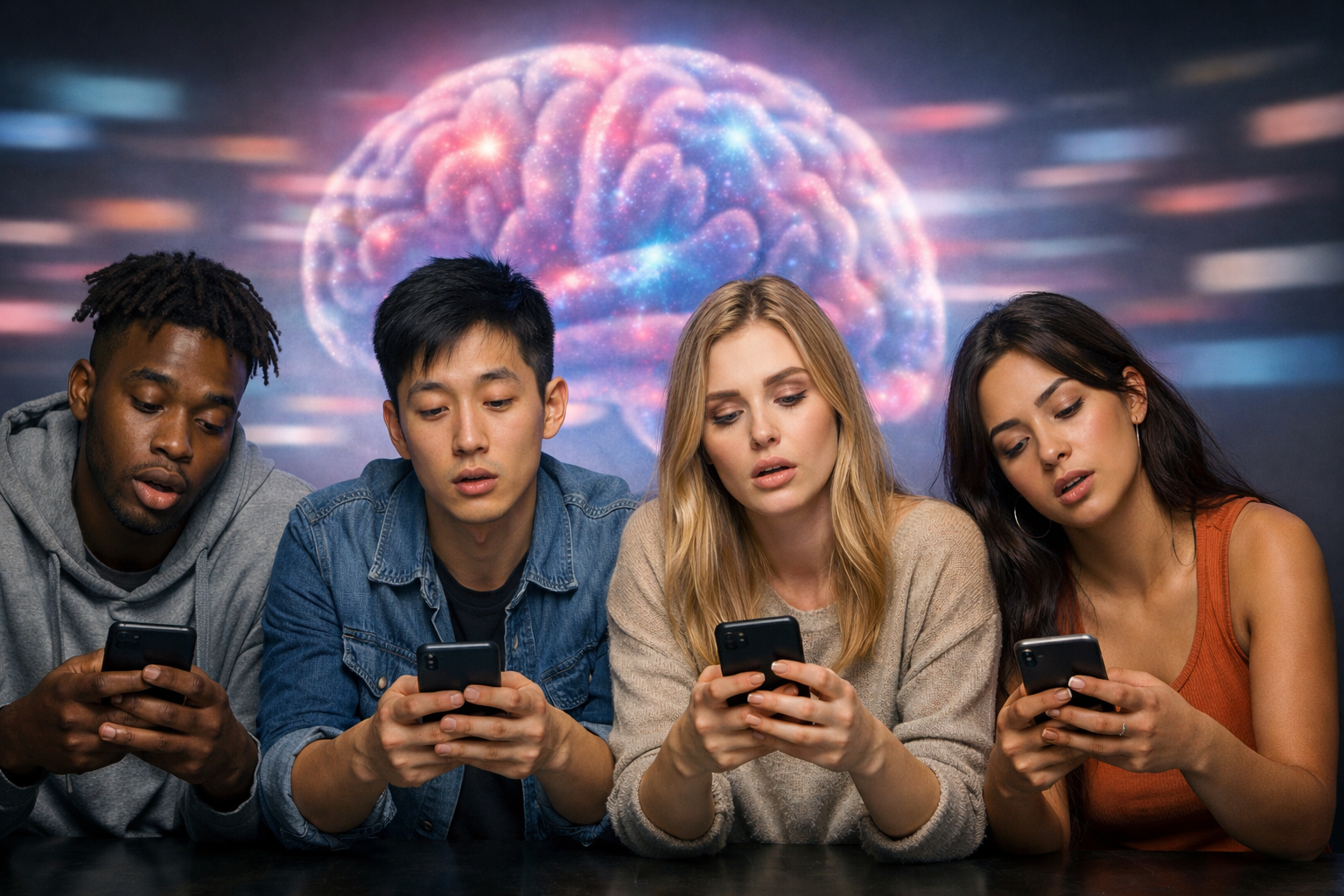

There was a time when distraction was something that happened to you. A loud noise. A ringing phone. A knock at the door. Now distraction is something you carry in your pocket, engineered, optimized, and refined with extraordinary precision.
TikTok is not just an app. It is a behavioral environment. It is a system designed to capture attention at scale, study that attention, and refine itself based on how human minds respond. When people say they “lost an hour,” they are not exaggerating. They are describing what happens when a design built for retention meets a brain built for novelty.
The conversation around endless scrolling usually drifts toward personal discipline. We tell ourselves we need more willpower. More control. Fewer bad habits. That framing is convenient, but incomplete. The more honest question is not why individuals lack restraint. It is what kind of cognitive patterns a system like this is quietly rewarding.
The Architecture of Endless Novelty
At the core of TikTok’s design is frictionless novelty. You do not search. You do not choose deliberately. You swipe. The next piece of content arrives instantly, selected by an algorithm that has already calculated what is most likely to keep you engaged.
That design removes pause. It removes deliberation. It removes the small moments where a person might decide whether to continue or stop. In older media formats, effort created natural boundaries. You had to pick up a book, turn on a television, or load a website. Now, a thumb movement keeps the stream flowing indefinitely.
The human brain is highly responsive to novelty. New stimuli trigger dopamine release because novelty once signaled opportunity or threat. In an environment of constant novelty, that reward system stays activated. The result is not simply enjoyment. It is conditioning.
Over time, the mind becomes accustomed to rapid shifts in stimulus. Eight seconds of humor. Twelve seconds of outrage. Fifteen seconds of advice. Then another shift. And another.
This is not neutral.
The Fragmentation of Attention
Attention is not just focus. It is the gateway to reasoning. Sustained attention allows ideas to connect, arguments to develop, and insights to deepen. When attention fragments, thinking fragments with it.
Endless scrolling trains the mind to expect interruption. Each swipe resets context. The brain must discard one frame of reference and adopt another almost instantly. Cooking demonstration. Political rant. Relationship story. Financial tip. Comedy sketch. Each one demands a small cognitive reset.
One reset is harmless. Hundreds are not.
When this pattern becomes habitual, sustained concentration begins to feel unnatural. Reading long-form writing requires effort that feels disproportionate. Complex problems feel more taxing. Even conversation can start to feel slow if it lacks constant stimulus.
The system rewards rapid reactivity. It does not reward contemplation.
That distinction matters more than we admit.
The Illusion of Intellectual Engagement
TikTok contains educational content. There are credible experts who distill psychology, history, finance, and science into short segments. It is possible to learn something useful in under a minute.
But learning and exposure are not the same.
True understanding requires sustained engagement with an idea. It requires wrestling with ambiguity, sitting with complexity, and sometimes feeling confused before clarity arrives. Endless scrolling short-circuits that process. It delivers the highlight, not the depth. The conclusion, not the argument.
A person can consume dozens of informational clips in a single session and feel intellectually stimulated. The brain experiences novelty and interprets it as enrichment. Yet very little of that content is processed deeply enough to reshape long-term understanding.
It feels like growth.
It is often just motion.

Algorithmic Incentives and Cognitive Narrowing
The TikTok algorithm does not exist to broaden your mind. It exists to maximize engagement. That distinction explains much of what follows.
The system studies micro-behaviors: pauses, rewatches, likes, shares. It refines your feed accordingly. Over time, your content becomes increasingly tailored to your preferences, emotional triggers, and past behavior. What you see feels personalized because it is.
But personalization narrows exposure.
If you linger on political outrage, you will see more of it. If you pause on lifestyle luxury, it will multiply. If you engage with niche viewpoints, those viewpoints will become more dominant in your feed. The algorithm optimizes for retention, not intellectual diversity.
The result is subtle cognitive narrowing. Not because anyone intended harm, but because engagement metrics reward familiarity and emotional activation. Over time, this creates echo chambers that feel organic but are mathematically reinforced.
Critical thinking requires friction with opposing ideas. Algorithmic curation reduces that friction.
The Erosion of Boredom
Boredom once played a structural role in mental life. It created empty space where reflection could occur. In moments of waiting, the mind wandered. It replayed conversations. It rehearsed future plans. It generated original connections.
Today, boredom is nearly extinct. A phone fills every pause. Lines, elevators, short breaks, and quiet evenings are all colonized by content streams. The mind rarely sits without input.
Neuroscience research shows that the brain’s default mode network activates during rest. This network is associated with memory consolidation, self-reflection, and creative insight. When we eliminate downtime, we reduce opportunities for that deeper processing.
Constant consumption replaces synthesis.
We become highly informed about fragments and less practiced at integrating them.
Young Minds, Plastic Systems
For adolescents, the stakes are higher. The developing brain is particularly sensitive to repeated patterns. Neural pathways strengthen based on frequent use. A system built on rapid reward cycles can shape expectations around speed, feedback, and stimulation.
This does not mean young people are doomed. It means their cognitive environment matters. When daily experience revolves around high-frequency novelty, slower forms of learning may feel less rewarding by comparison. Reading dense material, practicing complex skills, or engaging in long-term projects may feel unusually difficult.
The brain adapts efficiently.
It adapts to what it practices.

Adults Are Participating Too
It would be comforting to limit concern to teenagers. Adults, however, are deeply embedded in the same systems. Professionals scroll after work. Parents scroll late at night. Leaders scroll between meetings.
The assumption is that maturity protects cognitive resilience. That assumption is questionable. Neuroplasticity does not end at adulthood. Habits continue shaping neural patterns across the lifespan.
An executive who spends hours in fragmented media consumption should not be surprised if sustained strategic thinking feels harder. A writer who scrolls constantly may struggle to maintain narrative depth. The mind reflects its training environment.
This is not a moral judgment. It is a structural observation.
Is the Platform the Villain?
It would be simplistic to frame TikTok as malicious. The platform is responding to economic incentives. Attention is profitable. Retention drives revenue. Engineers optimize for measurable engagement because engagement can be quantified.
What cannot be easily quantified is intellectual depth.
The system does not measure whether a user has strengthened reasoning capacity. It measures how long they stayed. The incentives shape the design. The design shapes behavior. Behavior shapes cognition.
No conspiracy is required.
Only alignment of profit and psychology.
What Is Actually at Stake
The concern is not that short videos exist. The concern is scale and dominance. When rapid, algorithmically curated content becomes the primary cognitive diet for millions of people, cultural thinking patterns shift.
Patience decreases. Nuance becomes harder to tolerate. Complex arguments lose audience share to simplified narratives. Emotional activation spreads faster than careful reasoning.
A society that struggles with sustained attention will struggle with sustained problem-solving. Civic issues, scientific challenges, and ethical debates require long-form thinking. They require citizens capable of holding multiple variables in mind without immediate reward.
Endless scrolling conditions the opposite skill set.
Quick reaction. Rapid judgment. Continuous stimulus.
It is efficient for engagement.
Less so for wisdom.

Reclaiming Cognitive Agency
The solution is not digital abstinence. It is awareness of structure. Individuals who understand the incentive landscape can make deliberate choices about their participation.
Intentional boundaries restore friction. Designating time for long-form reading rebuilds attention endurance. Allowing unfilled space reintroduces boredom’s creative function. Diversifying information sources counters algorithmic narrowing.
These are not dramatic acts. They are quiet forms of resistance.
The deeper shift, however, is cultural. We must recognize that intellectual wellness is not merely personal self-care. It is a public good. A thinking population requires environments that support depth, not just engagement.
The algorithm will continue optimizing.
The question is whether we will.
In the end, the issue is not whether TikTok is entertaining. It is what kind of minds our systems are cultivating. A society trained on perpetual novelty may become highly reactive and perpetually distracted. A society that protects depth preserves its ability to reason.
The architecture is powerful.
But it is not inevitable.
And that distinction is where responsibility begins.
If something here resonated, don’t rush past it.
Growth rarely needs a dramatic overhaul. It needs a small, intentional pause and a better next step.
Join the Good Time To Shine newsletter for thoughtful reflections, practical tools, and a free guide designed to help you check in with your whole life, not just the loud parts.
No pressure. No noise. Just support that meets you where you are.
Subscribe and download the free guide.
One thoughtful step is enough for today.
Canty