
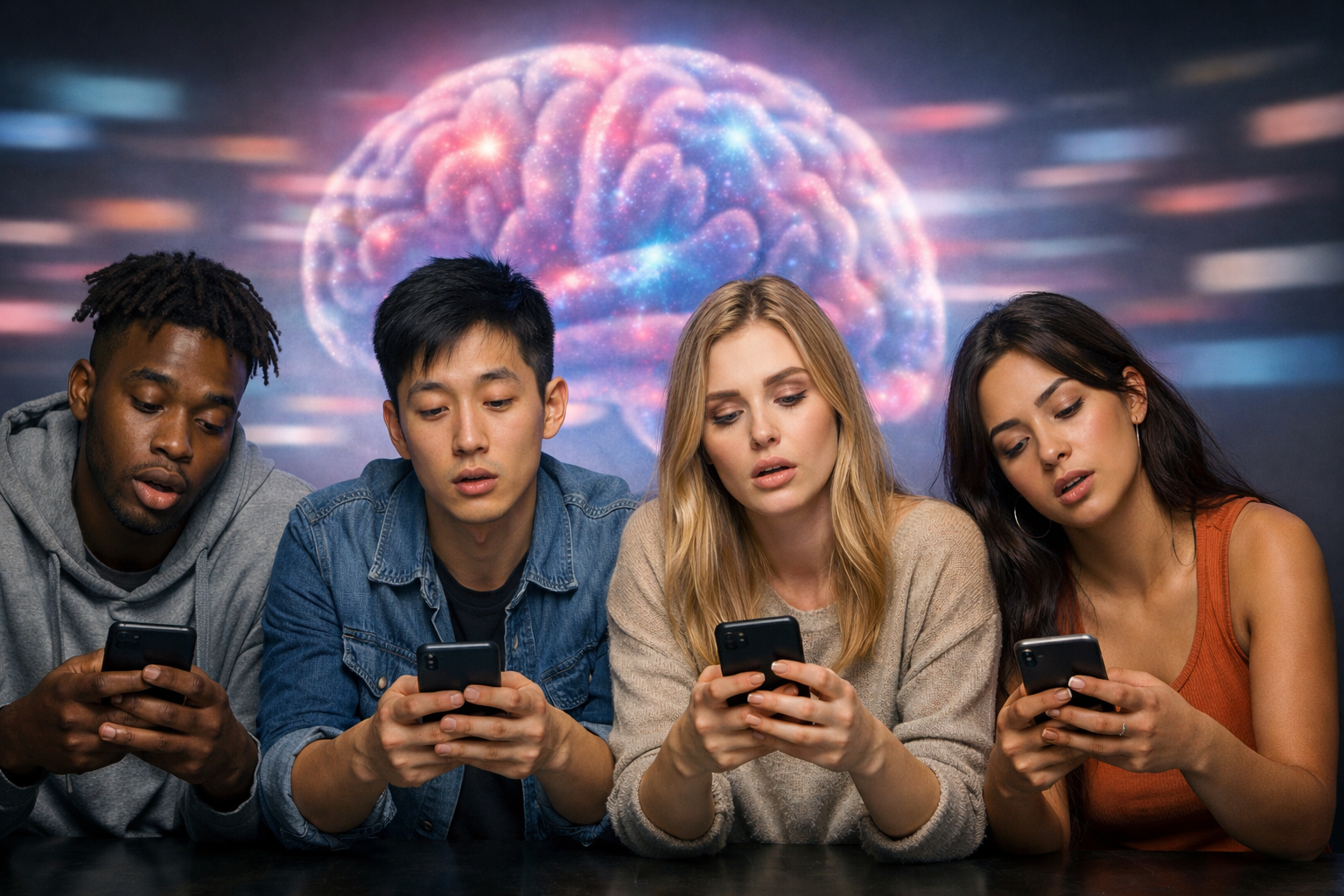


The Distraction You Designed Yourself
There was a time when distraction was something that happened to you from outside. A loud noise. A ringing phone. A knock at the door. Now distraction is something you carry in your pocket, engineered, optimized, and refined with extraordinary precision by people whose job is to make sure you never fully put it down. The shift is more significant than it sounds. External distractions interrupt. Internal ones operate on a different level entirely, because you keep returning to them voluntarily, often without fully deciding to.
TikTok is not just an app. It is a behavioral environment, a system designed to capture attention at scale, study that attention in real time, and continuously refine itself based on how human minds respond to what it serves. When people describe losing an hour without intending to, they are not exaggerating or confessing a moral failure. They are describing what happens when a design built specifically for retention meets a brain built specifically for novelty. The conversation around endless scrolling almost always drifts toward personal discipline, willpower, and bad habits. That framing is convenient for the platforms and incomplete for everyone else. The more honest question is not why individuals struggle to stop. It is what kind of cognitive patterns a system like this quietly rewards over time.
The Architecture of Endless Novelty
At the core of TikTok’s design is frictionless novelty delivered without pause or deliberate choice. You do not search for content. You do not select it with intention. You swipe, and the next piece arrives instantly, selected by an algorithm that has already calculated what combination of content is most likely to keep your attention moving forward rather than stepping back. That design removes the small deliberative moments where a person might naturally decide whether to continue or stop. Older media formats created natural friction through effort: you had to pick up a book, navigate to a website, or actively choose what to watch next. That friction functioned as a series of small decision points that gave the user real agency over their time.
The human brain is highly responsive to novelty because new stimuli historically signaled either opportunity or threat, both of which required attention to navigate. In an environment of constant, algorithmically optimized novelty, the brain’s reward system stays activated not as a response to something genuinely significant but as a response to a system that has learned to trigger that response reliably. The result is not simply enjoyment of content. It is conditioning toward a particular rhythm of experience: eight seconds of humor, twelve seconds of outrage, fifteen seconds of advice, then another shift, another reset, another small dopamine signal telling your brain that something worth noticing just happened. That rhythm, repeated hundreds of times in a session, is not neutral in its effects on the mind that practices it.
The Fragmentation of Attention
Attention is not merely the ability to focus. It is the gateway to reasoning itself. Sustained attention is what allows ideas to connect across time, arguments to develop past their initial premises, and insights to deepen beyond surface recognition. When attention consistently fragments, thinking fragments alongside it. Each swipe on a short-form video feed resets context almost entirely: the brain must discard one frame of reference and immediately adopt another, moving from a cooking demonstration to a political argument to a relationship story to a financial tip without transition or integration time between them.
One context reset is cognitively harmless. Hundreds of them, practiced as a daily habit across months and years, reshape the baseline that feels normal for the brain’s attention system. When this pattern becomes sufficiently habitual, sustained concentration begins to feel effortful in a way that feels disproportionate to the task. Reading long-form writing requires a level of continuous engagement that starts to feel unusual rather than ordinary. Complex problems feel more taxing than they previously did. Even conversation can begin to feel slow when it lacks the continuous stimulus density the brain has been trained to expect. The system rewards rapid reactivity and immediate emotional response. It does not reward the slower, quieter process of contemplation that produces genuine understanding rather than just the feeling of it.
The Illusion of Intellectual Engagement
TikTok contains genuinely educational content. Credible experts distill psychology, history, science, and financial concepts into short segments that are sometimes remarkably well-constructed. It is entirely possible to encounter a useful idea in under sixty seconds. But learning and exposure operate differently in the brain, and conflating them leads to a persistent and flattering misunderstanding of what is actually happening during an educational scroll session.
True understanding of any complex idea requires sustained engagement with it. It requires sitting with ambiguity long enough to work through it, tolerating confusion without immediately moving to something more immediately rewarding, and allowing the brain to build connections between new information and what it already knows. Endless scrolling consistently short-circuits that process by delivering conclusions without arguments, highlights without context, and advice without the reasoning that makes advice genuinely applicable. A person can move through dozens of informational clips in a single session and walk away feeling intellectually stimulated, because the brain experiences novelty and interprets that experience as enrichment. Very little of that content, however, has been processed deeply enough to reshape long-term understanding or develop genuine competence. It feels like intellectual growth. It is often simply motion that carries the emotional signature of growth.

Algorithmic Incentives and Cognitive Narrowing
The TikTok algorithm does not exist to broaden your perspective or develop your reasoning capacity. It exists to maximize engagement, and that distinction explains much of what happens to people who use it heavily over time. The system studies micro-behaviors with remarkable granularity: where you pause, what you rewatch, what you share, what triggers a longer dwell time. It refines your feed accordingly, continuously. Over time, your content becomes increasingly calibrated to your existing preferences, emotional triggers, and behavioral patterns. It feels deeply personalized because it is.
But personalization of this kind narrows rather than expands exposure. If you linger on political outrage, the system serves more of it. If you pause on lifestyle aspiration, that content multiplies. If you engage repeatedly with a niche viewpoint, that viewpoint becomes structurally more dominant in your daily information environment, not because you sought it out deliberately but because engagement metrics rewarded the algorithm for showing it to you again. The result is a form of cognitive narrowing that feels organic and self-directed when it is actually mathematically reinforced. Critical thinking requires productive friction with ideas that challenge existing frameworks. Algorithmic curation is specifically designed to reduce that friction because friction reduces retention, and retention is the metric that matters to the system.
What Happens When Boredom Disappears
Boredom once played a structural role in mental life that most people did not recognize until it was gone. It created empty space where reflection could occur without agenda. In moments of waiting, the mind wandered productively: replaying conversations to understand them better, rehearsing future situations, generating connections between ideas that had not yet been consciously linked. That wandering was not wasted time. It was the brain doing a form of integration work that active consumption prevents.
Today, boredom is nearly extinct in daily life. A phone fills every pause: lines at the grocery store, elevator rides, the three minutes between a meeting ending and the next one beginning, quiet evenings that used to end in actual rest. The mind rarely sits with itself long enough to process what it has already taken in. Neuroscience research has consistently shown that the brain’s default mode network activates during rest and is associated with memory consolidation, self-reflection, and creative insight. When downtime is consistently colonized by content streams, opportunities for that deeper processing are replaced by more consumption. We become increasingly informed about fragments and progressively less practiced at integrating them into anything coherent or durable.
Young Minds in a High-Frequency Environment
For adolescents, the stakes attached to these patterns are higher than they are for adults, and the timeline for impact is shorter. The developing brain is particularly sensitive to repeated experience patterns because neural pathways strengthen based on frequent use during the years when the architecture of the mind is still being built. A system built around rapid reward cycles and high-frequency novelty can shape foundational expectations about what engagement, learning, and reward are supposed to feel like, before a young person has experienced enough contrast to recognize what is happening.
This does not mean young people who use these platforms are cognitively damaged or without recourse. It means their cognitive environment matters in specific ways that deserve honest attention from parents, educators, and the institutions responsible for supporting development. When daily experience is built primarily around high-frequency novelty and immediate feedback, slower forms of learning can begin to feel unrewarding by comparison in a way that is neurological rather than motivational. Reading dense material, developing complex skills over extended periods, and engaging with projects that require sustained effort without immediate validation may feel increasingly difficult not because the young person lacks capability but because the brain has been practicing a different rhythm. The brain adapts efficiently to what it practices most consistently, which means the environment it practices in carries more influence over its development than most people are comfortable acknowledging.

Adults Are Not Exempt From This
It would be easier if these effects were limited to teenagers, whose brains are still developing and therefore more obviously vulnerable. Adults, however, are deeply embedded in the same systems and operating under the same incentive structures. Professionals scroll between meetings and after work. Parents scroll late at night when the house is finally quiet. Leaders consume fragmented content streams throughout the day while managing organizations that require exactly the kind of sustained strategic thinking that fragmented attention undermines.
The assumption that maturity provides reliable cognitive protection from these patterns is worth questioning directly. Neuroplasticity does not end at adulthood. Habits continue shaping neural patterns across the entire lifespan, just more slowly than in developmental years. A professional who spends significant daily hours in fragmented media consumption should not be surprised when sustained strategic thinking begins to feel more effortful over time. A writer who scrolls heavily may find narrative depth increasingly hard to maintain for extended periods. The mind reflects its training environment regardless of age, and this is a structural observation about how the brain works rather than a moral judgment about how people choose to spend their time.
What Is Actually at Stake
The concern about short-form video platforms is not that they exist or that short content has no legitimate value. The concern is about scale, dominance, and what happens to cultural thinking patterns when rapidly curated, algorithmically optimized content becomes the primary cognitive diet for hundreds of millions of people simultaneously. When patience decreases at a population level, nuance becomes harder to sustain in public discourse. When complex arguments consistently lose audience share to simplified, emotionally activated narratives, the quality of collective decision-making declines in ways that affect everyone, including people who have managed their own consumption carefully.
Civic challenges, scientific problems, and ethical debates all require long-form thinking from populations capable of holding multiple variables in mind without immediate resolution or reward. These are the kinds of problems that do not yield to rapid reaction and continuous stimulus. They require exactly the cognitive capacity that the current design of dominant platforms systematically conditions against. The algorithmic incentives are aligned with engagement, which is measurable. They are not aligned with intellectual depth, which is not. No conspiracy is required to explain the outcome. Only the consistent application of profit-driven design to human psychology.

Reclaiming the Ability to Think at Full Depth
The practical response to all of this is not digital abstinence or dramatic declarations about deleting apps. It is awareness of the structural incentives at work, combined with deliberate choices about participation that account for those incentives rather than ignoring them. Intentional friction restores what frictionless design removes. Designating specific time for long-form reading, even when it initially feels more effortful than it once did, begins to rebuild attention endurance. Allowing genuinely unfilled space during the day reintroduces the boredom that has creative and integrative functions the brain needs. Deliberately diversifying information sources counters the algorithmic narrowing that feels like personalization but functions as intellectual narrowing.
None of these are dramatic actions. They are quiet forms of resistance to a design that is not neutral in its effects. The deeper shift required is recognizing that intellectual wellness is not purely personal self-care. It is a shared interest. A population capable of sustained reasoning, genuine nuance, and complex problem-solving is not an abstract social good. It is a practical requirement for navigating the actual challenges that face communities and institutions. The algorithm will continue optimizing for what it was built to optimize for. The question is whether the people using it will choose to optimize for something it cannot measure.
Call to Action
Your cognitive health is part of your overall well-being, and it rarely gets the same attention as physical health even when it is quietly shaping everything else. The Eight-Room Reset Guide includes a section on how you engage with your environment, including your digital environment, and was built to help you see what is actually affecting your daily experience before you decide what to do about it.
It is free, it takes less than twenty minutes, and it asks honest questions rather than offering a checklist of things you are already doing wrong.
Download the Eight-Room Reset Guide at Good Time To Shine and take one clear look at the full picture.
Ronnie Canty | Good Time To Shine