

You did everything right. You talked to your doctor. You tried the medication. Maybe you tried two or three. You waited the six weeks they told you to wait, and then you waited some more. And at some point you started wondering if the problem was not the drugs but you. That maybe your brain was just too broken to fix. That thought is wrong. But it is also incredibly common, and the fact that it is common says something important about how we have been treating mental illness for the past thirty years.
Antidepressants help a lot of people. That is real and worth saying clearly. But they do not help everyone, and for a long time the medical establishment did not have a great answer for the people they left behind. That is starting to change. Not because the old tools stopped working, but because researchers kept asking why they did not work for everyone, and the answers they found are opening doors that most people do not even know exist yet.

The Number That Should Have Changed Everything Sooner
About one in three people with major depression do not respond adequately to antidepressants. That is not a small edge case. That is tens of millions of people worldwide who took the standard treatment and did not get better. The term for this is treatment-resistant depression, and for a long time it was one of medicine’s quieter failures. Patients would cycle through medications, adjust doses, try combinations, and still end up in the same place. Frustrated, hopeless, and often blaming themselves for not getting better.
What researchers eventually realized is that depression is not one thing. It looks like one thing from the outside because the symptoms cluster together in recognizable ways. But underneath those symptoms there are different biological mechanisms at work, and a drug that targets one mechanism may do absolutely nothing for another. Asking why antidepressants do not work for everyone is a bit like asking why one antibiotic does not cure every infection. The answer is that the infections are not the same, even when they look similar.
Ketamine and the Fast-Acting Revolution
The biggest shift in treatment-resistant depression in decades came from an unlikely source. Ketamine has existed as an anesthetic since the 1960s and spent many years better known as a club drug than a medical treatment. But when researchers started studying its effects on depression, they found something that nobody expected. It worked fast. Not in six weeks. In hours, sometimes. For people who had not responded to anything else.
The FDA approved esketamine, a nasal spray form of ketamine, in 2019, and that approval marked a genuine turning point. It was the first new class of antidepressant approved in decades. It works by targeting glutamate, a different neurotransmitter than the ones most antidepressants focus on, and that difference matters. For people whose depression is driven by glutamate dysregulation rather than serotonin deficits, it can be the difference between suffering and relief. Ketamine is not for everyone and it comes with its own complexities. But its emergence proved that the field still had real breakthroughs ahead of it.
TMS: Rewiring the Brain Without Medication
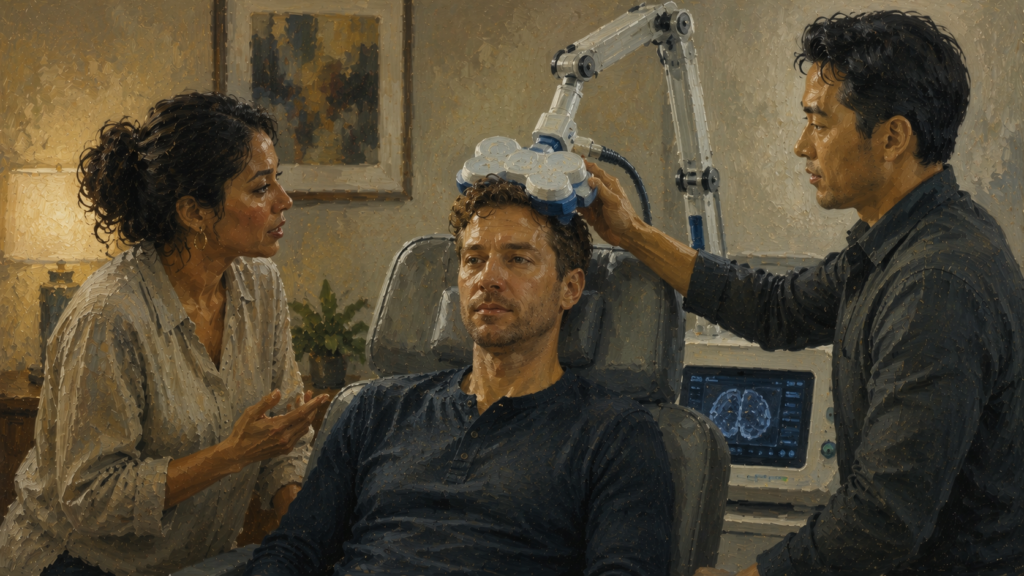
Transcranial magnetic stimulation, which most people call TMS, uses targeted magnetic fields to stimulate specific areas of the brain. It is non-invasive, meaning nothing goes into your body, and it has been FDA-approved for treatment-resistant depression since 2008. It did not become widely known until relatively recently because it was expensive, time-consuming, and not covered by many insurance plans. Those barriers have been dropping, and more people are discovering it as a real option.
The newer form of TMS, called deep TMS or theta burst stimulation, has dramatically shortened treatment times. The original protocol required 30-minute sessions over six weeks. Some newer versions take three minutes. The results for treatment-resistant patients are genuinely impressive, with response rates that compare favorably to adding a second medication without the side effects of adding more drugs to the mix. For people who cannot tolerate medication side effects or who have tried multiple drugs without success, TMS represents a fundamentally different way in.
Psychedelic-Assisted Therapy Is Not What You Think
The word psychedelic carries a lot of baggage. It conjures images that have nothing to do with sitting in a clinical setting with a trained therapist, working through the roots of trauma and depression in an environment designed to support healing. But that is exactly what psychedelic-assisted therapy looks like in the studies happening at Johns Hopkins, NYU, and institutions around the world. And the results for treatment-resistant depression and PTSD have been striking enough that the scientific community, which tends to move slowly, has been moving fast.
Psilocybin therapy and MDMA-assisted therapy are both in late-stage clinical trials. MDMA-assisted therapy for PTSD was submitted for FDA approval, though the path has been complicated by regulatory challenges. Psilocybin has received breakthrough therapy designation from the FDA, meaning the agency sees enough promise to expedite the review process. These are not fringe treatments backed by anecdotal claims. They are rigorously studied interventions that have produced results that conventional treatments have not matched for certain patient populations.
The Gut-Brain Connection That Changes the Whole Picture
One of the more surprising shifts in mental health research has been the growing evidence around the gut-brain axis. The idea that your gut microbiome, the trillions of microorganisms living in your digestive tract, has a significant influence on your mental health was considered speculative not long ago. It is no longer speculative. Research has established direct communication pathways between the gut and the brain, and disruptions in gut health have been linked to depression, anxiety, and cognitive function.
This does not mean you can cure depression with probiotics, and anyone claiming otherwise is overselling the science. What it does mean is that treatment approaches that only focus on the brain may be missing part of the picture for some people. Dietary interventions, microbiome research, and anti-inflammatory approaches to mental health are areas of active and legitimate scientific investigation. The researchers asking these questions are not operating on the fringes. They are working at major universities with rigorous methods, and their findings are accumulating.

What This Means If You Are Still Waiting
None of this is meant to hand you a to-do list at the end of a hard read. If you have been through the cycle of trying medications and waiting and hoping and landing back at square one, the last thing you need is someone telling you to just ask better questions. What might actually help is knowing that the people who study this for a living did not give up on you when the first treatment failed. They kept asking why. And the answers they found are not minor refinements. They are a different way of looking at the problem entirely.
The honest conversation to have with your doctor now looks different than it did five years ago. Asking directly about treatment-resistant depression, TMS, or ketamine-based options is not reaching for something experimental. It is asking about things that exist, work for real people, and are covered by real insurance plans in more places than they used to be. You are not being difficult by asking. You are being informed. And being informed is one of the few things in this situation that is fully in your control.
The suffering is real. So is the science catching up to it. You are not at the end of what is possible. You might just be at the beginning of a part of the map that nobody handed you yet.
Ronnie Canty | Good Time To Shine